The books that let you choose what happened next
From Fighting Fantasy books to branching digital journeys, and the childhood fascination that led me to build Routes of Fate.
When I was younger, I remember being absolutely fascinated by a particular type of book.
They weren’t really novels in the traditional sense. You didn’t simply start at page one and work your way through to the end. You made decisions along the way, and those decisions determined what happened next.
I think they were the Fighting Fantasy books. I can’t remember all the titles now, but I remember the experience of reading them.
You’d be following a story, reach a point where something happened, and suddenly you had a choice.
Do you open the door? Do you take the other path? Do you trust the stranger?
Depending on your decision, you’d be sent to a completely different page.
Sometimes things worked out. Sometimes they really didn’t.
I absolutely loved them.
A very early form of interactive design
Looking back now, with years of product design behind me, I find those books even more fascinating.
Because when you think about it, they were a pretty clever example of interactive design, long before most of us had anything resembling the digital experiences we use today.
There was a user journey. There were decisions, consequences, alternative routes and different outcomes.
All contained within a paperback book.
What I still find incredible is the amount of planning that must have gone into creating one.
I can almost picture the authors standing in front of an enormous wall, covered in bits of paper, with lines running in every direction. Different pathways connecting to other pathways. Decisions feeding into entirely different chapters.
And somewhere, probably, a printer quietly having a nervous breakdown trying to make sure all the page references were correct.
Imagine getting halfway through a book, being told to turn to page 137, and discovering you’d just landed in the wrong story.
The whole thing would fall apart.
It’s funny because, even today, when we’re mapping complex digital journeys in Figma or working through a prototype, we’re essentially dealing with some of those same problems.
Where does this decision take someone? What happens if they choose something else? Can they get stuck? Does the journey still make sense?
The technology has changed enormously, but the thinking behind it isn’t entirely different.
I’ve always enjoyed the darker stories
I’ve also always enjoyed writing.
Not necessarily the fantasy side of things, but mysteries, murder stories and psychological thrillers. The sort of stories where you’re never completely sure who to trust, and where one small detail can change how you see everything.
And I started wondering whether those two interests could work together.
What if you took the interactive storytelling I remembered from childhood and brought it into a more modern experience?
Not a traditional game, exactly. And not simply a digital book.
Something somewhere between the two.
An experience where you’re still reading a proper story, with characters, atmosphere and suspense, but you’re also responsible for some of the decisions being made.
Where you can make the wrong choice.
Where chance sometimes has a part to play.
And where someone else reading the same story might end up somewhere completely different.
That was the starting point for Routes of Fate.
Bringing an old idea into a modern format
The idea behind Routes of Fate is fairly simple.
I want to create short, interactive stories that people can read and play through on their phone, tablet or computer.
You follow the narrative, make decisions at key moments and occasionally leave something to chance with a roll of the dice.
Your choices influence the direction the story takes.
But the important thing for me is that it still feels like reading.
I don’t want to lose the enjoyment of a good story by turning every moment into a button, animation or game mechanic.
The writing needs to do the heavy lifting. The interaction should make you feel more involved, rather than constantly interrupting you.
And I think that’s an interesting design challenge in itself.
How much interaction is enough? When should someone make a decision? When should you simply let them enjoy the story?
There are plenty of things I’m still working out.
Which is part of the enjoyment.
The Last Train
The first story I’ve been experimenting with is called The Last Train.
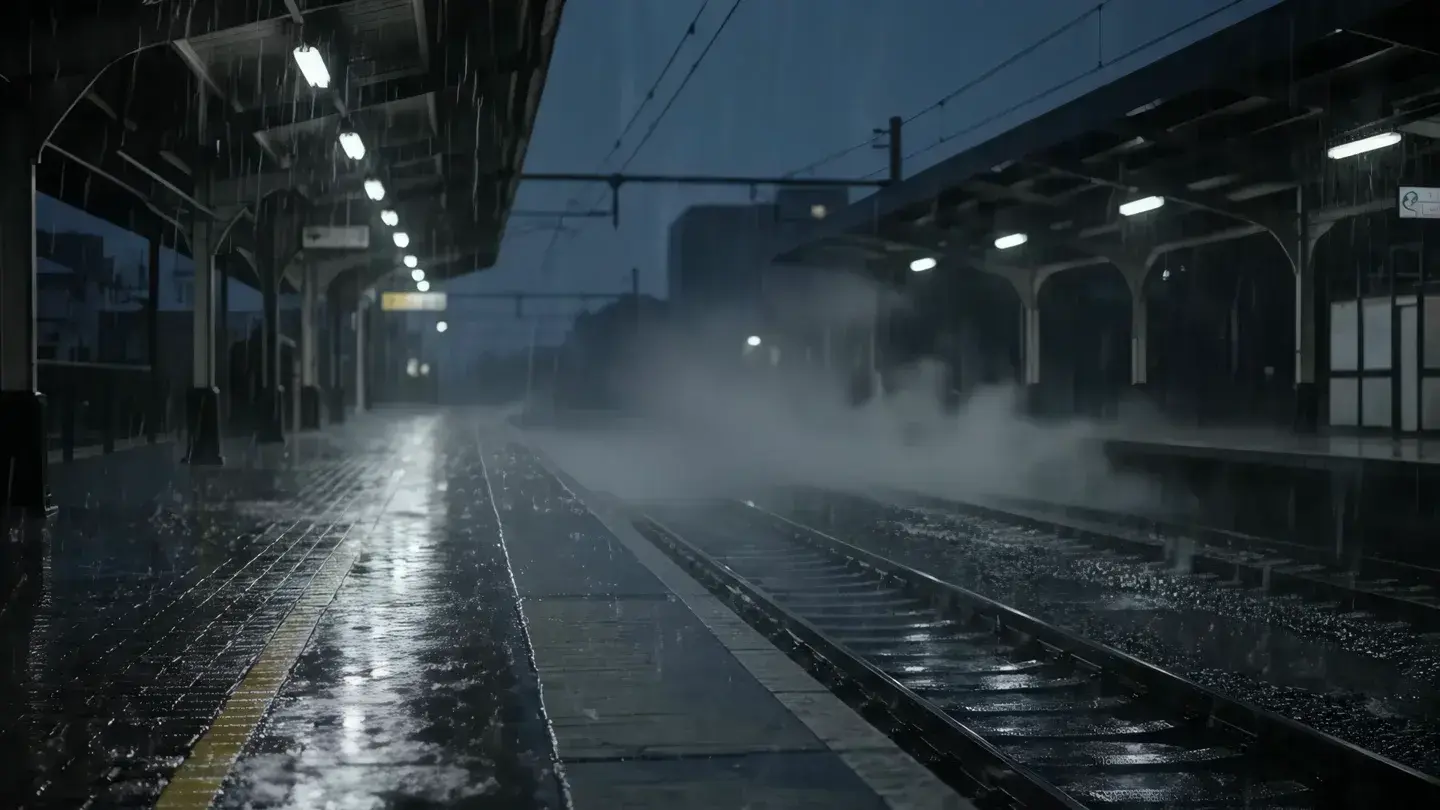
It’s a mystery set around a train that stops in a tunnel on Christmas Eve.
Twelve passengers boarded.
Now there are thirteen.
From there, you’re drawn into a story where you choose a character, investigate what has happened and make decisions about who to trust and what to do next.
Some decisions are straightforward. Others carry a little more risk.
And occasionally, a roll of the dice gets involved.
It’s still very much a pilot.
There are things I want to develop further, ideas I haven’t explored yet and plenty I’d like to improve. But rather than spend months trying to make everything perfect, I wanted to get something working and put it in front of real people.
I’ve spent a large part of my career helping businesses design and launch digital products. It’s quite refreshing to occasionally build something where the only brief is an idea that’s been sitting in your head for years.
No stakeholder meetings. No lengthy approval process.
Just an idea, a bit of curiosity and the question of whether anyone else might enjoy it.
Could this be another way to get people reading?
One thing I find particularly interesting is the possibility of encouraging people to read more.
We’re surrounded by short videos, social feeds, notifications and endless things competing for our attention.
And I’m as guilty as anyone of getting distracted by them.
But I wonder whether interactive storytelling might offer something slightly different.
Something that keeps the enjoyment of reading but gives people a little more involvement in what happens.
Maybe someone who wouldn’t normally pick up a novel would happily spend half an hour working their way through a mystery if they felt they had some control over the outcome.
I don’t know whether that’s true yet.
But I’d quite like to find out.
And I think that’s enough of a reason to experiment.
I’d genuinely love to know what you think
Routes of Fate is very much at the beginning.
The Last Train is the first experiment, and I’d love to develop more stories if there’s an appetite for them.
So if you fancy giving something a little different a go, you can try it here:
Play The Last Train on Routes of Fate
There’s also an opportunity to leave a star rating after you’ve played, which would be genuinely useful to me.
Not because I’m expecting everyone to love it, but because I’d like to understand whether it’s an experience people actually enjoy.
Does the story hold your attention? Are the choices interesting? Does the balance between reading and interaction feel right?
Or is it simply not your thing?
All of that is useful.
I suppose, in a strange way, I’ve come full circle.
Years ago, I was sitting there turning pages backwards and forwards, trying to work out which route to take through a book.
Now I’m sitting here trying to work out how to build those routes myself.
And I still find the whole idea just as fascinating.