I built an app and 10,000 people used it
BoshBets started as a way to understand what was really happening behind a tipster’s large Twitter following. It became an app used by around 10,000 people, a platform for multiple tipsters, and one of the most useful things I’ve ever built.
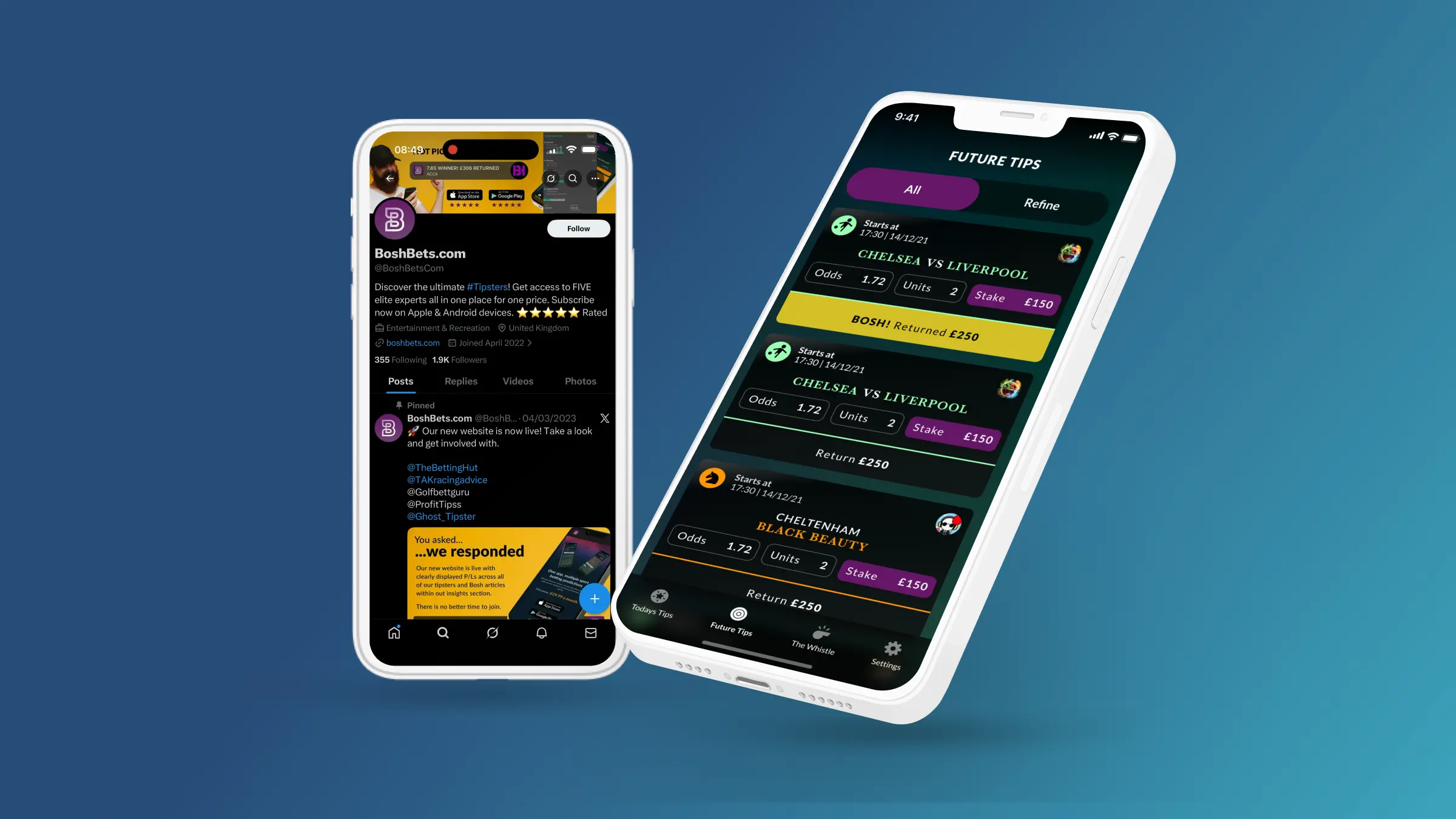
BoshBets started because a friend of mine was a betting tipster.
He had somewhere between 10,000 and 15,000 followers on Twitter and, at the time, that was effectively his entire audience. People followed him for his tips, some paid for access to his membership channel, and from the outside it looked like a pretty successful setup.
The problem was that we didn’t really know what those numbers meant.
Having 15,000 followers sounds great, but how many of them are actually paying attention? How many are active? How many come back regularly? And how many followed you two years ago and have barely looked at anything since?
Twitter gave him a large following, but very little understanding of the people behind it.
That was where BoshBets started.
The idea was to build something that gave him a more direct relationship with that audience and, at the same time, allowed us to understand whether people were actually engaging with what he was putting out.
It started with one tipster
The original version was fairly straightforward.
He would have an app where he could publish his tips, send notifications and communicate directly with the people following him.
Behind that, we could start seeing what was actually happening.
Were people opening the app? Were they looking at his tips? Were they coming back? Was the audience as engaged as the Twitter follower count suggested?
But once we started exploring it, the idea quickly became bigger than one tipster.
If one person could bring their audience into the app, why couldn’t another?
You could have somebody specialising in football, somebody covering horse racing and someone else covering tennis.
Even within those sports it could become surprisingly specific.
One football tipster might focus on match results. Another could specialise in goals. Someone else might concentrate entirely on yellow cards and red cards.
The more we looked at it, the more interesting that became.
Every new tipster potentially brought their own audience with them. But once those people were inside BoshBets, they could also discover other tipsters and other types of betting.
So there was value on both sides.
The tipsters gained exposure to a wider audience, while their followers suddenly had access to more than the one person they had originally come to see.
At least, that was the idea.
The app was only the front of it
One of the things I realised quite quickly was that building an app meant building considerably more than an app.
The thing sitting on somebody’s phone was only the visible part.
The tipsters still needed somewhere to publish everything, so we also built a web based back end where they could add their selections and manage the information going into the app.
There was a news feed too.
That allowed somebody to go beyond simply publishing a tip and explain the thinking behind a selection in more detail.
It also gave us somewhere to handle the bigger moments in the sporting calendar.
Cheltenham. Royal Ascot. The World Cup.
Those periods could generate a huge amount of activity, so having somewhere for more substantial content made sense.
Then there were notifications.
Notifications were one of the reasons for building the app in the first place. They gave tipsters a direct way of telling somebody that a new selection had gone live.
But there was an obvious problem.
If you give a growing group of very enthusiastic tipsters the ability to send notifications whenever they like, somebody’s phone can become extremely annoying very quickly.
So we ended up having to police them.
A tipster couldn’t simply send whatever they wanted whenever they wanted. Notifications had to come through us first so we had some control over how often users were being contacted.
It sounds obvious now.
It wasn’t something I had thought about when we started.
That became a recurring theme with BoshBets.
You could design the product as carefully as you liked, but real people would always introduce something you hadn’t planned for.
I ended up doing nearly everything
I worked with a developer who built the product properly and dealt with the more complicated technical side.
Almost everything around that became my responsibility.
The proposition, product, UX, UI, branding, social media, marketing, App Store listings, content, acquisition, communications and working with the tipsters themselves.
There wasn’t another team to hand things over to.
If we needed more users, I had to work out how to get them.
If something wasn’t clear, I had to fix it.
If the App Store wanted something changed, I had to deal with it.
And when those changes meant more development work, the money was coming out of my own pocket.
That part changes your relationship with product decisions quite quickly.
It is one thing for a stakeholder to ask for another change when you’re working on a client’s product.
It feels rather different when your immediate reaction is: that’s my money you’re asking me to spend.
But I enjoyed a lot of it.
There was a genuine buzz around the product when it was busy.
Tips would go out. Bets would start coming in. Social media would light up. Somebody would say they’d just won £500 and suddenly everybody was excited.
It was fun.
I also learned an enormous amount about betting, probably far more than I ever expected to know.
There is obviously another side to that buzz as well. When people are winning, the feeling can become very strong. When they’re losing, they’re losing real money.
I’m quite glad I was able to work in that world without ever making betting a significant part of my own life.
Then 10,000 people used it
Within the first year, around 10,000 people had used BoshBets.
For me, that was a huge moment.
I’d already spent years designing digital products professionally, but this felt completely different.
These weren’t research participants we’d recruited to test a prototype.
Nobody was being paid to look at it.
They were strangers finding something we’d built, going into the App Store, downloading it and deciding whether it deserved to stay on their phone.
We pushed the product hard through Twitter, social media and the audiences the tipsters had already built.
Some of that worked really well. Some of it didn’t.
But for the first time I could see what happened when an idea I’d been involved with from the very beginning was put in front of thousands of real people.
You could see the acquisition.
You could see the engagement.
You could see what people looked at and what they ignored.
And you could start finding out whether the proposition we’d imagined at the beginning actually stood up in the real world.
You stop talking about “the user” in quite the same way once there are 10,000 actual people on the other side of the product.
The hardest problem wasn’t technical
There were technical problems along the way.
There were App Store problems.
There were things we had to redesign, rebuild or rethink.
But eventually the hardest part became something I hadn’t really designed for at all.
The people.
The whole BoshBets proposition depended on different tipsters bringing their audiences together.
On paper, that was one of the strongest parts of the idea.
Someone who arrived because they followed one football tipster could discover another. They might then find somebody covering racing, tennis or a completely different type of bet.
The network became more valuable as more people joined it.
In reality, some of the tipsters became extremely protective of their followers.
Arguments started on Twitter.
People accused other tipsters of stealing their users.
There were fallings out, little social media battles and disagreements about whose audience belonged to whom.
It became surprisingly catty.
Maybe I had been naive about that part of it.
I had spent a lot of time thinking about how the product would work.
I had spent considerably less time thinking about how the personalities inside the product would work.
Eventually I reached the point where I realised I wasn’t particularly interested in being a school teacher.
I had built a product.
I hadn’t built it so I could referee arguments between grown adults on Twitter.
That was probably the point where my enthusiasm for continuing with it started to disappear.
So I sold it
One of the tipsters using BoshBets was doing particularly well and wanted to continue with the product.
That made things relatively easy.
There wasn’t some grand acquisition process. I didn’t spend months trying to find a buyer.
There was somebody already using the platform who understood what it did, wanted it for himself and was in a position to buy it.
So I sold it to him.
I handed over the code, put him in touch with the developer and transferred everything he needed to continue running it.
And that was effectively the end of BoshBets for me.
Where it is today, I genuinely don’t know.
I haven’t seen the original product in the stores for a long time. The company and branding no longer exist, so perhaps it was rebuilt under another name. Perhaps it changed into something else. Perhaps eventually it stopped altogether.
Hopefully it did what the new owner wanted it to do.
By then, I’d got an enormous amount from it anyway.
Would I do it again?
Absolutely.
I probably wouldn’t do it in exactly the same way.
Nothing really prepares you for the amount of work involved in building and running something yourself.
And nothing really prepares you for paying for it yourself either.
If I built something similar today, I’d probably look for some financial backing much earlier rather than continually reaching into my own pocket whenever something needed changing, fixing or rebuilding.
But I would definitely build another product of my own.
BoshBets taught me things I don’t think I could have learned by simply designing another client product.
I saw the whole thing.
The original idea. The proposition. The design. The development. Marketing. Acquisition. Content. App stores. Users. Operations. Money. Personalities. Problems I hadn’t anticipated.
And eventually, selling it.
It was probably one of the best things I’ve done professionally.
Not because 10,000 is some extraordinary number in the world of consumer apps.
It was because they were 10,000 real people using something that had started as an idea between me and a friend.
I built an app and 10,000 people used it.
That part was brilliant.
Everything around it was probably where I learned the most.